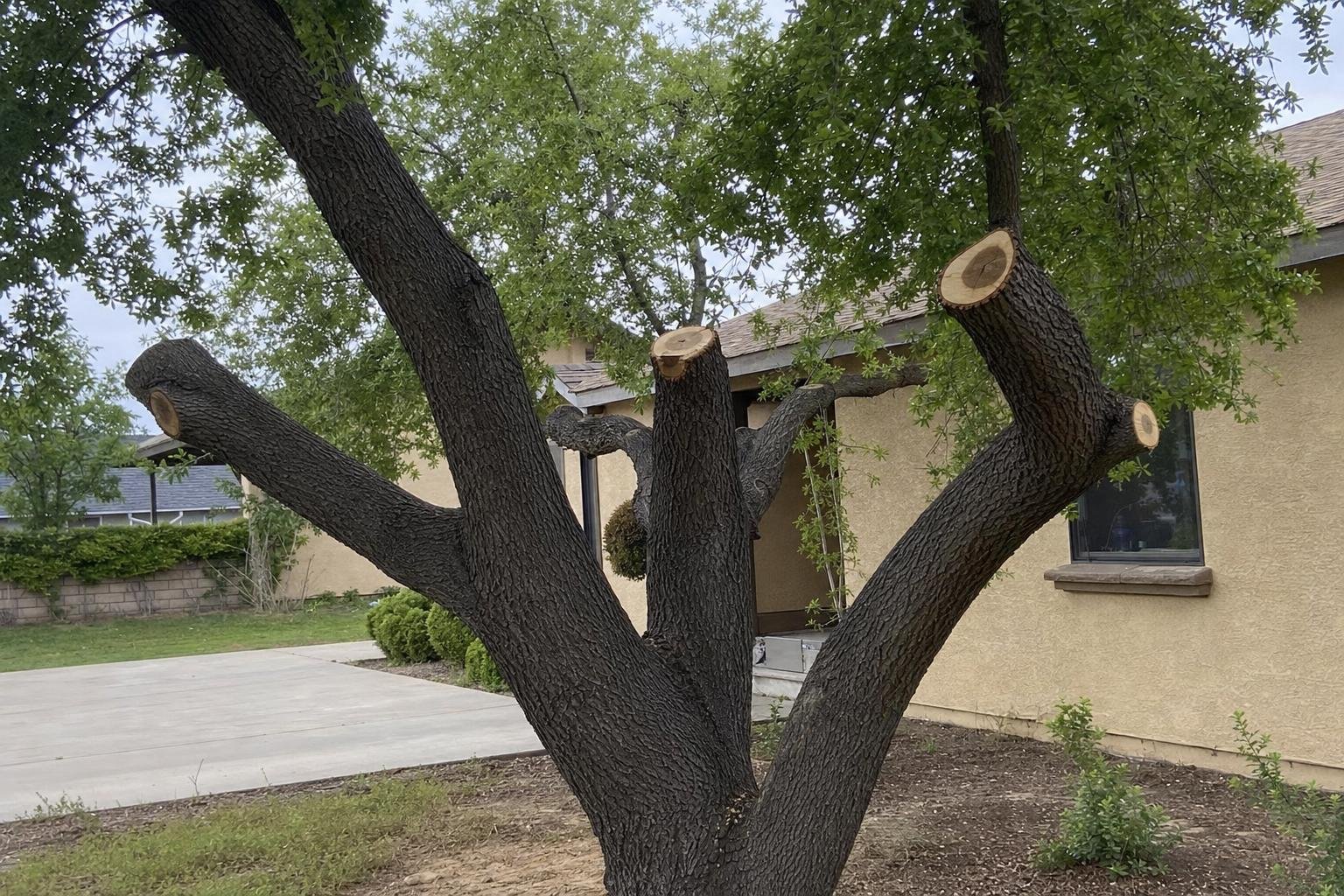
It's for the tree that's still healthy but getting ahead of your house. If you want to keep the tree and a limb has become a nuisance or a worry, this is the job. The final figure follows a look at the tree itself.
Signs a tree is due
Look up. Branches rubbing the roof or hanging over the shingles. Limbs reaching toward a fence, a neighbor's wall or the wires. Dead, leafless wood in an otherwise leafy crown. Branches crossing and chafing each other. A canopy so dense that the grass underneath has thinned out.
Any one of those is reason enough to call. We'd rather look at it early, when the fix is a handful of clean cuts, than after a limb has come down on its own.
Often paired with tree removal. Need tree service in Visalia? Start on our home page.
Related reading: Tree Service Step by Step: What the Job Involves · How to Choose a Tree Service Contractor: What a Good Quote Spells Out
What we do up in the tree
We decide what the tree should look like when we're done, then cut toward that. Small and mid-size growth comes off with a hand pruning saw. Higher limbs we reach with a pole saw where that's the right tool.
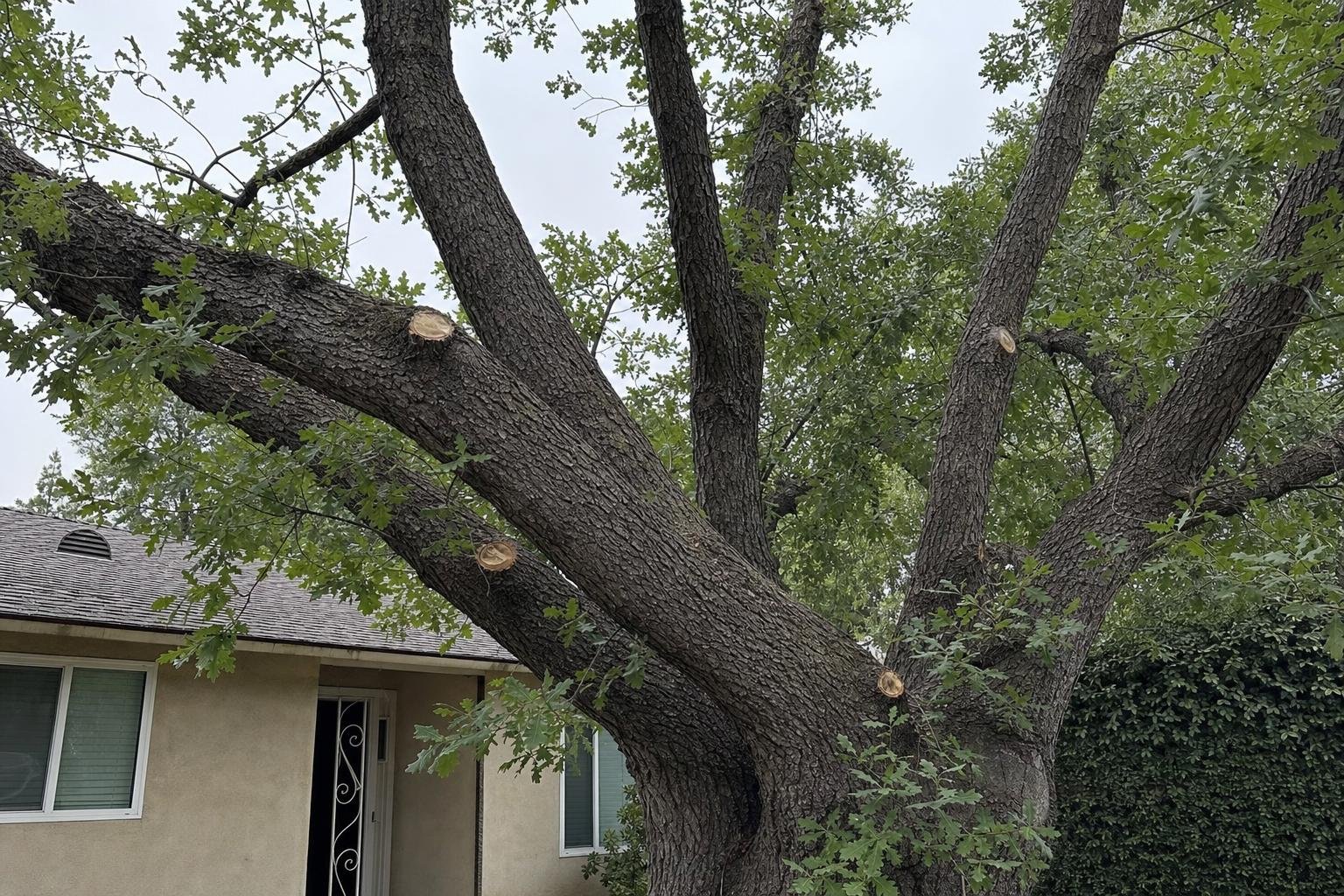
Heavy branches get two cuts, not one. The first goes farther out along the limb and takes off the weight, so the branch doesn't tear bark on its way down. The final cut lands just outside the branch collar and the branch bark ridge, the swollen ring where the branch meets its parent. Cutting flush to the trunk leaves a bigger wound than it needs to.
When a limb is simply too long, we shorten it instead of removing it. That's a reduction cut: we trim back to a side branch about one-third to one-half the diameter of the piece coming off. The limb stays, just shorter and lighter.
How long it takes
A single modest tree is a shorter visit than a big canopy that needs weight taken off in stages. The time follows the number of heavy limbs that need the two-cut method, how many reductions the crown needs, and whether a hand saw or the pole saw is doing most of the work. Tight access over a roof or fence slows things down too.
When we quote, we tell you what that means for your tree and your yard.
Water, drains and where you live
Visalia sits in a warm, mixed climate (zone 3B). The part people forget after pruning is the debris. The city sends much of its rainfall through storm drains to groundwater-recharge basins and wants drainage areas kept clear of brush, so we keep cuttings out of those paths.
The St. Johns River and overland flow from the east are the city's primary flood sources.
Ready for a number? Get in touch and tell us what's bothering you about the tree, and we'll go from there.
Other Services We Offer
Pieces of the Work
On a typical job, a few of the specifics:
- Preserve sturdy branches with wide angles when possible, and cut out weak V-shaped junctions with included bark.
- For heavy limbs, make an initial cut on the underside a few inches from the branch collar to minimize bark damage.
Straight Answers
Talk it through with us at (559) 557-4251, and there's nothing to sign.